the one where you pick up your phone and wonder why
You're staring at the home screen, wondering why you picked it up. There wasn’t a notification. But now here you are, with no idea of what you actually intended to do.
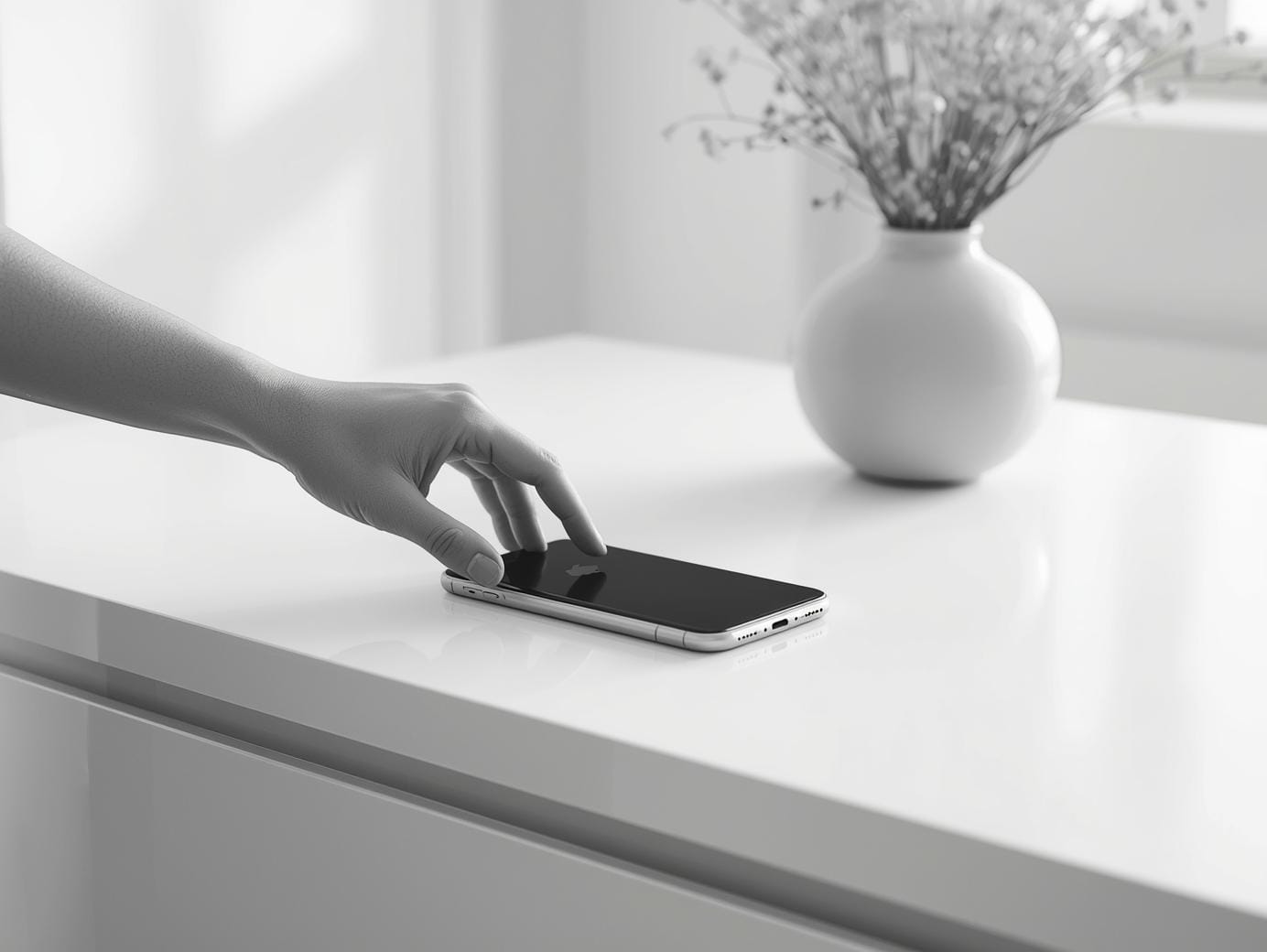
You're standing in your kitchen. There’s something you need to be doing so you have the impulse to move. Whatever it was wasn’t phone related, but moments later you find yourself holding your phone.
So now you're staring at the home screen, wondering why you picked it up. There wasn’t a notification. You’ve already checked the weather app three times today. But now here you are, with no idea of what you actually intended to do.
What was that impulse? Was it habit? Misdirected action? An addiction?
Maybe it was by design.
the gap between intention and hands
There's a way to think about this that avoids just blaming lack of willpower. Psychologists call it the Reflective-Impulsive Model, but really it's just naming something you already know: you've got two systems running at the same time, and they don't always agree.
Your reflective system is where intentions live. It's the part of you that decided to focus on work, or finish that email, or get back to the kitchen task you started with. It's conscious. It thinks ahead. It knows what you're supposed to be doing.
Your impulsive system doesn't care about any of that. It responds to what's in front of you right now. A notification. The weight of your phone in your pocket. That feeling of being stuck on something hard. Through repetition, your impulsive system has learned to link these triggers to a reward. Boredom means phone equals relief. Stuck on a problem means phone equals distraction. The association is automatic. When the trigger shows up, your hand moves. You don't deliberate. You don't decide. You just…do.
So when you find yourself staring at the home screen with no memory of why you picked it up, that's not a failure. That's your impulsive system automatically reaching for something it's been trained to associate with reward. Your reflective intention to focus exists in a completely different system. The two can work against each other, but the impulsive system has the advantage because it doesn't require effort. It just goes.
your phone is already working on you just by being there
There is a body of neuroscience research suggesting that the mere presence of your smartphone reduces your ability to focus properly on other things. There is also some research suggesting that younger generations may be adapting, but if you didn’t grow up with a smartphone in your hand, ignoring the expensive little oblongs that hold our entire lives is likely to be more difficult.
When we’re focussed on a task with our phone nearby, our brains are automatically working to inhibit the urge to check it, even when you're not consciously aware this is happening. Imagine a tiny Homer Simpson inside your head saying “Don’t look, don’t look, don’t look. Oh…I looked.” Your prefrontal cortex (the part responsible for self-regulation) is already engaged before you've made any choice at all.
"Even when people are successful at maintaining sustained attention—as when avoiding the temptation to check their phones—the mere presence of these devices reduces available cognitive capacity."
Brain Drain
The research shows this isn't about willpower or distraction in the traditional sense. It's about brain power being redirected to the task of not looking at the device. And that redirection happens subconsciously until the moment you wonder why you picked it up.
So when you're standing in your kitchen with a vague intention that you need to be doing something, your already-taxed attention is vulnerable. Your brain is primed to engage with the most accessible action object nearby. And 20 minutes later you find yourself on Instagram.
environmental priming: always within reach
Your phone didn't end up in your hand by accident. There's a system at work, and it starts with placement.
Think about what your phone is made of, how durable it is, and how much it cost. The glass screen alone is expensive to replace, let alone the whole phone. Your whole life is basically on there. So you make sure your phone is placed carefully in your bag or pocket when you go out. It probably has a special pocket of its own. And it's always with you when you go out, because it's so convenient to pay for coffee, show your driver's licence, and even open your front door, with the thing that’s always in your hand.
That deliberate placement becomes environmental priming. This isn’t just about content, but about availability itself triggering the habit. The closer your phone is, the more salient it becomes—and the more likely you are to reach for it without thinking.
So you've rationally placed your phone close. That rational choice has become the architecture that makes automatic behavior inevitable.
frictionless by design
Liquid Glass aside, there are some very clever people in charge of the design and engineering of the expensive piece of hardware you hold in your hand. Your phone is designed to be engaged with. Once it’s in your hand, the interface does the rest. Every choice made by designers has been optimized to keep you engaged with minimal resistance.
It’s smaller than a laptop. Faster to unlock than anything else. Just look at it (and you have to look at it). And then you're on the home screen, with red notification badges sitting at the corner of app icons that you yourself have arranged in a way that is most convenient for you. The interface is designed to make the next tap as easy as possible.
This is where stimulus salience meets interface design. Those notifications are cues that trigger your attention whether you like it or not. We’re given the semblance of control of what we’re notified about, but unless you turn them all off altogether, you’ll always be notified by some new category the app makers have come up with. And once you tap, that scroll is infinite.
So the phone's placement got you to pick it up. And once you're there, you’re there.
the pattern underneath
Finding yourself on your phone when you didn’t really mean to is a symptom of something broader. The digital systems that we live with are designed to draw and keep our attention, which has led to these behaviors becoming the easiest course of action. Your body learns the path of least resistance: reach, unlock, look, tap. It becomes a reflex.
The broader implication here is about agency. When the most accessible tool is engineered to capture attention, your choices narrow. Not because you lack discipline, but because a system has been engineered to make a particular choice easiest.
Research on choice architecture shows that what might appear to be neutral is actually designed for a particular response. Your phone's homescreen isn't built just to help you do a task quickly; it's also built to keep you there.
the question at the end
So next time you find yourself with your phone in your hand and wondering how you got there, know that the answer isn’t a lack of willpower. You're experiencing the interaction between automatic systems, environmental priming, and very slick and intentional design.
So the question becomes: what would it take for the frictionless default to align with what you actually intend to do? What would have to change—in your environment, in the design of the device, in the way systems are built—for the mismatch between intention and action to stop happening?
That's the real question worth asking.
further reading
Brain Drain: The Mere Presence of One's Own Smartphone Reduces Available Cognitive Capacity by Ward, Duke, Gneezy & Bos (2017)
The foundational research showing that just having your phone nearby—even if it's turned off and face-down—reduces your ability to focus. This is where the "brain drain" concept comes from.
Does the Mere Presence of a Smartphone Impact Cognitive Performance? A Meta-Analysis of the "Brain Drain Effect" by Douglas A. Parry (2024)
A recent review of all the research on this topic. It weighs up the evidence and shows which situations the brain drain effect is strongest (it's not always, but it's real enough to matter).
"Consent by Delight": How Viral, Playful AI Experiences Blur Privacy Risk Perception and Ethical Boundaries by Joongho Lee (2025)
How app designers use choice architecture—defaults, prompts, social proof—to make it easier for you to do what they want than what you want. Covers notification design, interface patterns, and why low-friction features are so effective.
Options to design more ethical and still successful default nudges: a review and recommendations by Dominic Lemken (2021)
How defaults work, and why transparent defaults (where you know something's been designed) are just as effective as hidden ones. Shows that designers often choose non-transparent defaults anyway—which is the point.
Habit Formation and Behavior Change by Benjamin Gardner & Amanda L. Rebar How habits form through repetition, context, and reward—and why environmental cues (like phone placement) matter more than willpower.